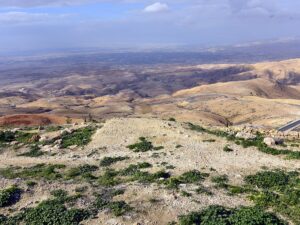
The Dead Sea sits at the lowest point on the surface of the earth, roughly 1443 feet below sea level, a vast salt lake shimmering at the bottom of the Jordan Rift Valley between the hills of Jordan and the Judean Desert. The water, so saturated with minerals, creates a buoyant effect that keeps people naturally afloat without effort, and people have been coming to these shores to bathe for thousands of years.
The region carries deep scriptural weight. The cities of Sodom and Gomorrah are believed by many scholars to have stood near its southern shores. The wilderness stretching back from its banks is understood to be the desert where Jesus fasted for forty days and faced the temptation of the devil, and the place to which John the Baptist retreated and where people traveled to hear him preach. The Scrolls discovered at Qumran transformed what we know about the Old Testament text and its transmission through history. There is almost no direction you can look from this shoreline without encountering something that matters to the story of Scripture. As for ancient history, above the Dead Sea looms the majestic and tragic Masada fortress built by Herod the Great.
An afternoon at the Dead Sea tends to be one of the lighter moments of a pilgrimage. The float is genuinely remarkable and hard to describe, the mineral-rich mud is a tradition going back centuries, and the horizon over the water in the late afternoon light is something to see
Photo Credit: Farah moghrabi, CC BY-SA 4.0, via Wikimedia Commons.